Sustainability
Responding to Climate Change
Tighter greenhouse gas (CO2) emission regulations aimed at realizing a decarbonized society and an increase in natural disasters due to climate change may pose a risk for the Group’s overall financial condition. At the same time, by developing products acceptable to a decarbonized society, this situation can also lead to business opportunities.
To that end, The RIKEN TECHNOS GROUP has set GROUP-wide goal of carbon neutrality by 2050, and is striving to introduce renewable energy and promote energy conservation in order to alleviate climate change. In addition, in order to adapt to climate change, we have formulated a BCP and established a system to minimize damage and loss.
Our Group has also announced our support for the recommendations of the Task Force on Climate-related Financial Disclosures (TCFD), and we undertake initiatives and information disclosure in line with the recommendations.
Task Force on Climate-related Financial Disclosures (TCFD)

This is an industry-led task force established in 2015 by the Financial Stability Board (FSB) in response to G20’s intention. The task force recommends the evaluation of financial impact of risks and opportunities arising from climate change on management and disclosure in four thematic areas (governance, strategy, risk management, and metrics and targets) (Official website of TCFD: https://www.fsb-tcfd.org/)
Metrics and Targets
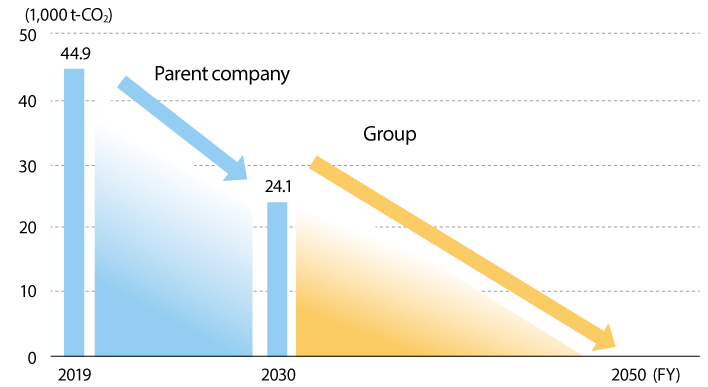
The Group seeks to achieve carbon neutrality for the entire Group by FY2050. In addition to setting medium- to long-term CO2 emissions reduction targets for the Group as a whole, we have been planning specific initiatives to reduce CO2 emissions and have determined indicators to manage the progress of these initiatives.
| Indicators | Scope | Unit | FY2022 | FY2023 | FY2024 | Medium- to Long-term Targets | |
|---|---|---|---|---|---|---|---|
| FY2027 | FY2030 | ||||||
| CO2 emissions (Scope 1 and 2) | non-consolidated | t-CO2 | 41,139 | 40,859 | 38,017 | 29,792 | 24,139 (46.2% decrease compared to FY2019) |
| consolidated | t-CO2 | 86,220 | 86,520 | 79,539 | - | - | |
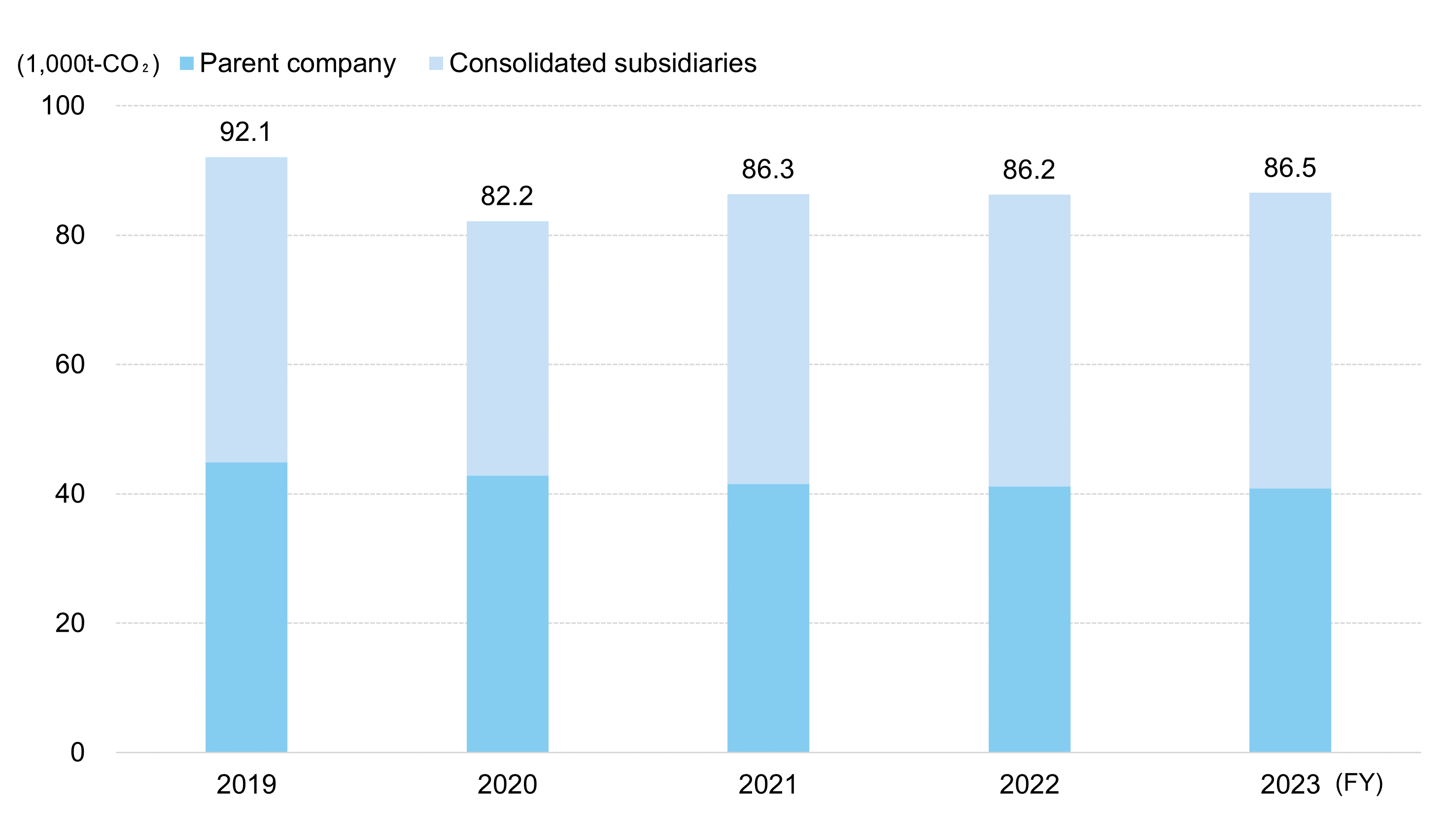
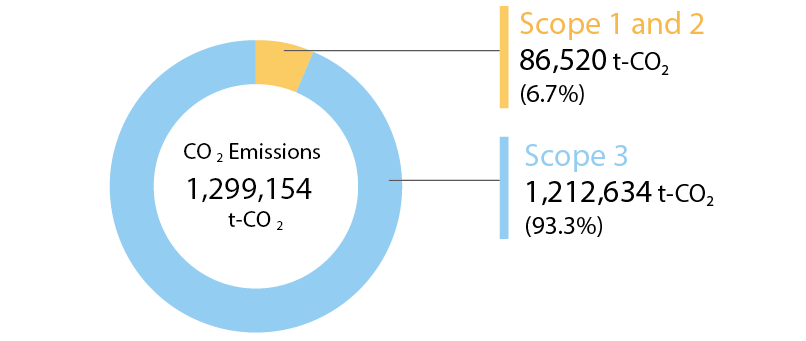
Our Group’s CO₂ Emissions (FY2024)
| Category No. | Category Name | Emissions(t-CO2) |
|---|---|---|
| 1 | Purchased raw materials and services | 927,476 |
| 2 | Capital goods | 13,041 |
| 3 | Energy not Included in Scope 1 or Scope 2 | 9,881 |
| 4 | Upstream transportation and distribution* | 891 |
| 5 | Waste generated in operations | 696 |
| 6 | Business travel | 246 |
| 7 | Employee commuting | 864 |
| 9 | Downstream transportation and distribution* | 5,945 |
| 12 | End-of-life treatment of sold products | 207,523 |
*Category 4 and 9 emissions concerm RIKEN TECHNOS only.
The Sustainability Committee
The following climate-related topics are deliberated by the Sustainability Committee.
Main topics deliberated by the Sustainability Committee
- Climate-related scenario analysis
- Identification and materiality assessment of short-, medium-, and long-term climate-related risks and opportunities
- Strategic approach policy for identified significant climate-related risks and opportunities
- Consideration of specific measures for responding to climate-related risks and opportunities
- Management of progress with adopted measures for responding to climate-related risks and opportunities
Sustainability Promotion Structure
Scenario Analyses
The RIKEN TECHNOS GROUP has performed scenario analyses for the years 2030 and 2050 in the context of climate change based on two world views: a 1.5℃ and a 4℃ rise in global temperatures. In our analysis, we refer to the scenarios disclosed by the government bodies and research institutes listed in the table below:
| World View | Scenarios Used in the Analysis |
|---|---|
| 1.5℃ | World Energy Outlook (WEO), IEA, 2023 |
| Net Zero Emissions by 2050 (NZE) | |
| Shared Socio-economic Pathway (SSP1-1.9), IPCC, 2021 | |
| 4℃ | Stated Policy Scenario (STEPS), IEA, 2020 |
| Representative Concentration Pathways (RCP6.0, 8.5), IPCC, 2014 |
With the scenario with a rise in global temperatures by less than 1.5℃, we presume, as risks with substantial financial impact, emergence and increases in development and procurement costs associated with the introduction of a carbon tax and shifts from conventional raw materials to low-carbon raw materials. With the scenario with a 4℃ rise in global temperatures, potential risks include increases in the prices of raw materials derived from petrochemicals, raw material procurement costs, expenses to address environmental regulations, and costs associated with petroleum and coal-derived raw materials and fuels, among others.
Centered on the Sustainability Committee, we identify the short-, medium-, and long-term climate-related risks and opportunities to assess their materiality and financial impact, formulate specific measures against identified risks and opportunities, and manage the progress of such measures.
Risks
The Group's performance may be affected by the introduction of policy measures to combat climate change, such as a carbon tax, or by delays in the development of or other action concerning environmentally friendly products.
| Risk Type | Risk Overview | Financial Impact | Impact Term | ||
|---|---|---|---|---|---|
| 1.5℃ | 4℃ | ||||
| Transition risk | Policies and regulations | Increased carbon taxes raise costs of procuring key raw materials and energy. | Medium | Small | Long-term |
| Policies and regulations | The introduction of a carbon tax results in the substitution of conventional raw materials with low-carbon raw materials, which generates or increases costs associated with the development and procurement costs of substitute raw materials. | Large | - | Medium-term | |
| Technology | Delays in the development of environmentally friendly products and their replacement our products with low-carbon products from competitors could reduce demand for and sales of our products and services. | Medium | - | Medium-term | |
| Markets | Prices of raw materials derived from petrochemicals soar, raising costs of procuring raw materials. | Small | Large | Long-term | |
| Markets | Delay in responding to our customers’ reduced needs for petroleum-derived raw materials and rising needs for non-petroleum-derived raw materials, shifts demand away from our products/services and decreases our sales. | Medium | - | Medium-term | |
| Reputation | Delayed action on the environment causes a drop in our stock price due to a decline in investors' assessment of our environmental performance. | Medium | - | Medium-term | |
| Physical risk | Acute | The Company and its supply chain are struck by a disaster and until operations are restored, sales decrease due to the suspension or reduction of business activities, while costs associated with restoration and countermeasures rise. | Medium | Medium | Medium-term |
| Chronic | Costs of countermeasures for our buildings located near oceans and rivers increase due to the increased occurrence of flooding caused by overflowing rivers and rising sea levels attributable to extreme fluctuations in rainfall and weather patterns. | Small | Medium | Short-term | |
Opportunities
The Group’s performance may be affected by the development of products that contribute to energy conservation and the provision of low-carbon type products and materials with added functions.
| Opportunity Type | Opportunity Overview | Financial Impact | Impact Term | |
|---|---|---|---|---|
| 1.5℃ | 4℃ | |||
| Energy sources | Development of products that contribute to energy conservation in the market and the uptake of renewable energy generation technologies and equipment increase sales of our related products. | Small | - | Short-term |
| Products and services | Demand for and sales of our products increase due to the development and sale of materials with additional functions and products with fewer petroleum-derived components (low-carbon type products) in response to increased demand for low-carbon type products. | Medium | - | Medium-term |
| Reputation | Proactive efforts to address climate change earn the trust of stakeholders and enhance our enterprise value. | Medium | - | Short-term |
| Resilience | The global expansion of our business sites improves our resilience by providing a stable supply of products to our customers even in an environment of increasing natural disasters, forestalling sales declines and building customer trust, leading in turn to higher sales. | Small | Small | Short-term |
Carbon Neutrality Initiatives
In addition to developing and enriching our environmentally friendly products such as the RIKEBIO® series, we are working on renewals of factory lighting and manufacturing-related facilities to those with less energy consumption, the introduction of EV forklifts, and the use of fuel-efficient vehicles.
Formulation of Road Map toward the Achievement of CO₂ Emissions Reduction Targets
Following the road map for RIKEN TECHNOS, we have been working on the formulation and implementation of measures to reduce CO₂ emissions.
In addition, we further promote this initiative by introducing an internal carbon pricing system for capital investments expected to reduce CO₂ emissions and incorporating this system in our process for making investment decisions.
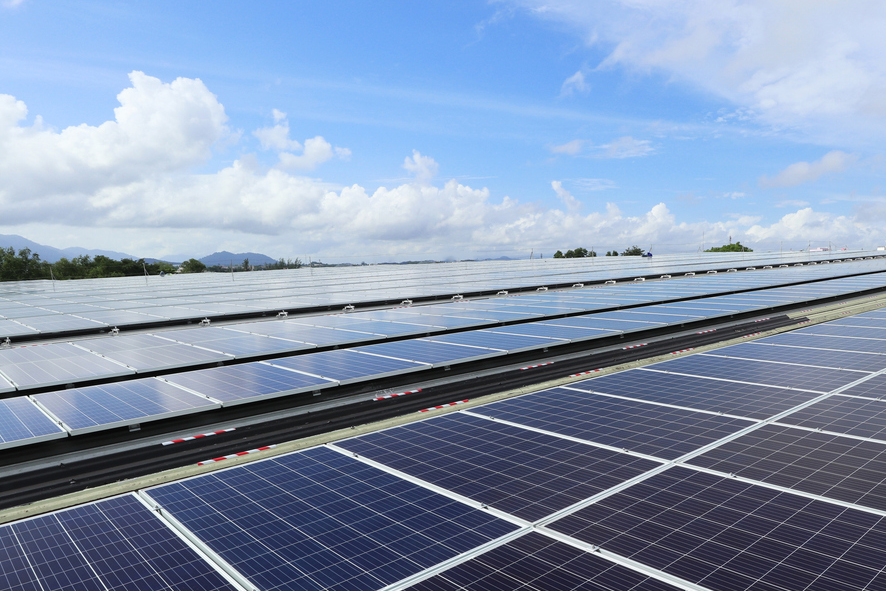
We also introduced solar power generation facilities to factory buildings of a consolidated subsidiary in Thailand as an investment in the renewable energy field.
Future Initiatives
- Refining of the Energy Road Map
- Boiler energy conversion
- Introduction of additional solar power generation facilities
- Upgrades of facilities at production sites and energy conservation of existing facilities
- Expansion and increased sales of environmentally friendly products
Adaption to Climate Change
Business Continuity Plan and Business Continuity Plan and Response to Emergency Situations