News
2026/06/25
RIKEN TECHNOS Develops “Microbial Composite” Plastics Through Industry-Academia Collaboration
Launch of a Nature-Positive Demonstration Project
RIKEN TECHNOS CORPORATION (Head Office: Chiyoda-ku, Tokyo; Representative Director, President & CEO: Kazuaki Tokiwa) has been conducting research and development on environmentally compatible materials utilizing microorganisms.
In collaboration with RIKEN (a National Research and Development Institute) and Sermas Co., Ltd. (Head Office: Ichikawa-shi, Chiba Prefecture ), a university-origin startup, the company has developed an original “microbial composite” material technology that immobilizes microorganisms within plastics while preserving their functions.
This technology disperses specific microorganisms within biodegradable plastics, enabling the material to maintain sufficient mechanical properties during use while expressing microbial metabolic and environmental functions under certain environmental conditions.
In addition, the material enables controlled release of microorganisms, allowing gradual emission into the surrounding environment. It is expected to be applied to the restoration of oceans and lakes, including water purification and the enhancement of blue carbon ecosystems.
This research integrates RIKEN TECHNOS’ polymer design and processing technologies, RIKEN’s fundamental research capabilities in environmental microbiology*1, materials informatics*2, and medical and immunological sciences*3, and Sermas’ expertise in thermophilic and heat-resistant microorganisms*4. It comprehensively studied aspects from material design to nature-positive environmental applications.
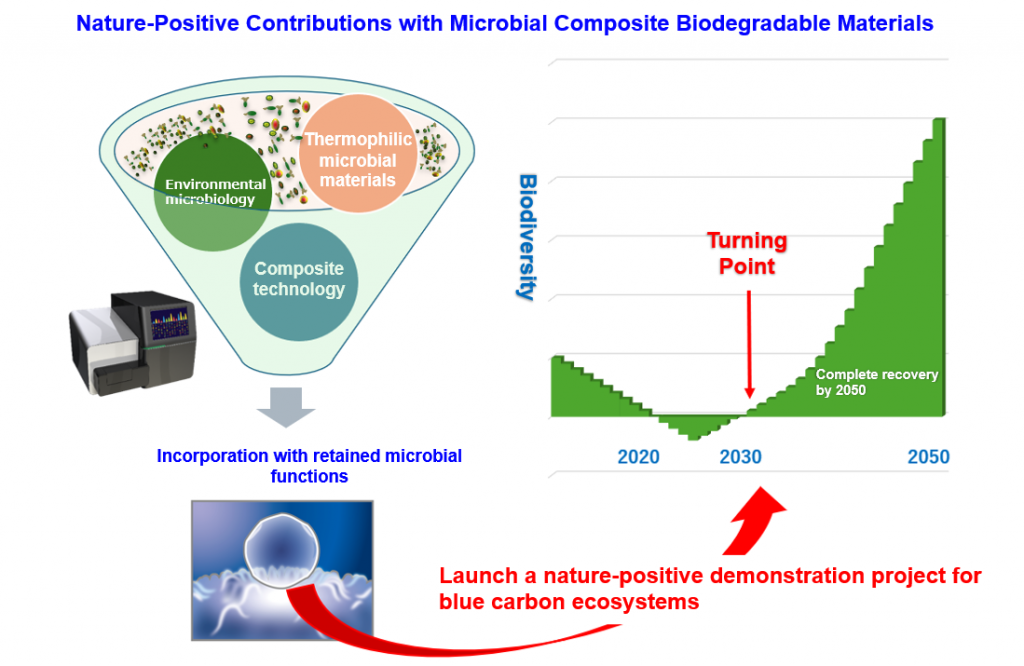
- Overview and Results of Joint Research
A technology for incorporating microorganisms into materials while maintaining their survivability and functionality was established under this joint research. This allows the design of new materials that exhibit function depending on environmental conditions.
Specifically, a plastic material that maintains mechanical properties even in aquatic environments while retaining and exhibiting microbial functions was successfully developed.
For example, it was confirmed that it is possible to impart a function that gradually releases microorganisms (controlled release) while retaining their functions in an aquatic environment. In this way, it is expected to be applied to technologies for the restoration of oceans, lakes, and marshes, such as water quality purification and the improvement of blue carbon habitats that contribute toward being nature-positive.
Furthermore, the possibility of maintaining microbial metabolism and controlling the release of enzymes and metabolites within plastic materials was demonstrated. These results indicate potential for applications in a broader range of environmental conditions beyond aquatic environments, and it can be expected to contribute toward the One Health approach and a nature-positive society.
- Significance of Research
The results of this research show a new technological foundation integrating microbial function and materials engineering. Technologies based on this foundation can also contribute toward dispelling the negative image of plastics, including those related to marine pollution, and provide direction for the design of new, next-generation nature-positive materials.
In addition, through cross-disciplinary integration of different fields—materials, microorganisms, and the environment—these technologies are expected to contribute toward the realization of a nature-positive society as technologies that help to solve social issues such as environmental impact reduction and ecosystem regeneration.
- Future Outlook
Going forward, this technology will be used as a foundation to advance the sophistication of environmentally friendly materials and applications for the restoration of aquatic environments, soil, and ecosystems, accelerating development toward social implementation.
As the first step toward social implementation, a demonstration project using the material as a carrier for blue carbon will commence at the Port of Yokohama in July 2026.
RIKEN TECHNOS will aim to create technologies that contribute to the realization of a sustainable society by integrating the fundamental research capabilities of RIKEN with the materials development and implementation capabilities of private companies.
References
*1
RIKEN press release dated May 15, 2014: Integrated evaluation and visualization of estuary sediment environmental analysis data
RIKEN press release dated May 2, 2018: Initiating of “environmental prediction science” for marine microbial ecology
RIKEN press release dated January 12, 2023: Estimation of symbiotic environments in seagrass bottom sediments for “blue carbon”
RIKEN press release dated May 13, 2024: How do “microbial communities” assemble?
*2
RIKEN press release dated June 23, 2025: “AI Prince Shōtoku” classify multiple voices and directs material development
RIKEN press release dated November 11, 2025: Equations for “Water-Holding Materials” derived from Machine-Learning
RIKEN press release dated December 23, 2025: Sustainable material design using universal-AI
*3
RIKEN press release dated September 1, 2023: Bacteria treatment reduces insulin resistance, protects against diabetes
RIKEN press release dated July 20, 2021: A simple compound to control complex gut microbes
RIKEN press release dated April 22, 2020:CD8+ regulatory T cells are critical in prevention of autoimmune-mediated diabetes (in Japanese)
RIKEN press release dated August 27, 2020: Tag team gut bacteria worsen symptoms of multiple sclerosis
RIKEN press release dated November 14, 2013: Fatty acid produced by gut bacteria boosts the immune system
RIKEN press release dated January 27, 2011: Discovery of “probiotic transporters” unlocks secrets of infection-preventive bifidobacteria
*4
RIKEN press release dated May 18, 2022: A causal structure of insect symbiotic bacteria involved in carbon and nitrogen cycling
RIKEN press release dated August 26, 2025: Toward sustainable aquaculture by innovation on fish body imaging diagnostics
RIKEN press release dated February 10, 2026: Resilience to heat stress and gut microbiota in livestock
RIKEN press release dated April 12, 2023: A causal model of compost-soil-plant interactions for sustainable agriculture
RIKEN press release dated March 25, 2022:Development of a novel feeding method for Japanese black calves with thermophile probiotics at postweaning (in Japanese)
RIKEN
https://www.riken.jp/
Sermas co., ltd.
https://www.sermas.co.jp/