News
2026/05/29
RIKEN TECHNOS Collaborates with Niihama College on Research to Develop a Novel Evaluation Method for Water Treatment Photocatalysts
RIKEN TECHNOS CORPORATION (Head Office: Chiyoda-ku, Tokyo; Kazuaki Tokiwa) has collaborated on research with National Institute of Technology (KOSEN), Niihama College (Niihama-shi, Ehime Prefecture; President: Akihiro Tokai; hereinafter, Niihama College) to establish a new method for evaluating water treatment photocatalysts with greater accuracy.
RIKEN TECHNOS and Niihama College have jointly developed an iron oxide photocatalyst for use in water treatment consisting of a porous matrix loaded with magnetic iron oxide particles. During evaluation of the material’s performance, the parties realized that it may not be possible to accurately assess organic matter degradation using conventional evaluation methods based on decolorization (a drop in visible light absorbance) as the sole indicator. The parties proceeded to establish a new evaluation method enabling a more multifaceted assessment encompassing situations where a solution had simply lost its color as well as the progress of organic backbone degradation and the formation of intermediates.
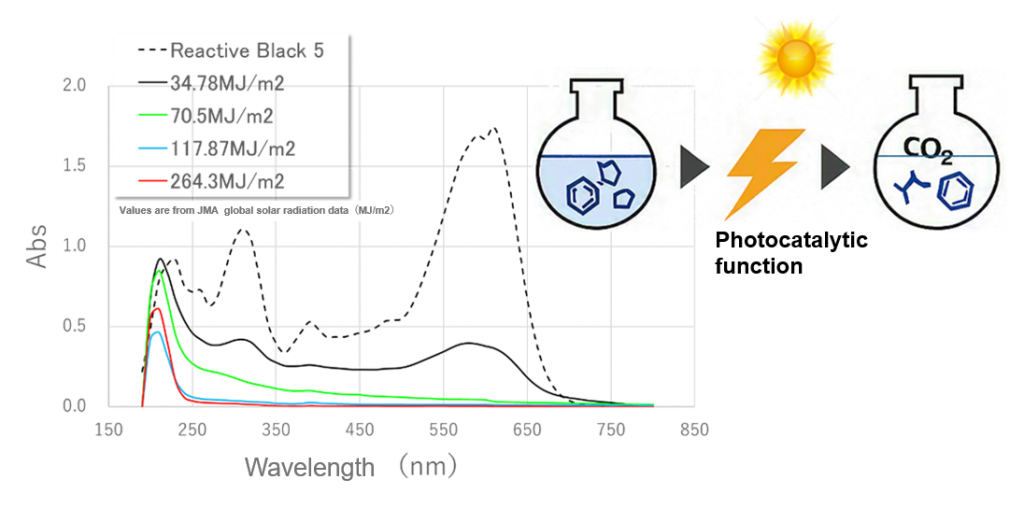
This involved an additional evaluation of absorbance changes in the deep ultraviolet (UV) region (around 230 nm).
1. Research Background
One widely used method for evaluating whether a photocatalytic water treatment technology degrades a target substance has been to observe the change in the color of the solution, indicating the decrease in absorbance of light in the visible range (approx. 400–700 nm). However, many organic dyes and refractory (persistent) organic substances have a highly stable organic backbone structure, such as an aromatic ring, and decolorization may occur even after changes within just some of the chromophores. For that reason, it might appear as if a target substance has been degraded when, in fact, it remains in the water with its organic backbone intact. This inability to accurately assess the degree of degradation that has occurred was one problem with the existing evaluation method.
2. Features of the New Evaluation Method
(1) Dual evaluation indicators covering visible light and deep UV
For this research, the change in absorbance in the deep UV region around the 200–250 nm range was adopted as an evaluation indicator alongside the existing indicator for visible light (decolorization evaluation). This deep UV range covers π-π* transitions originating from aromatic rings or low-molecular-weight organic matter, making the method effective for understanding the facts around remaining organic backbone structures and the degradation process (intermediate formation).
(2) Clear distinction between decolorization and organic backbone degradation
If only a decrease in visible light absorbance is observed, with no change within the deep UV range, it can be determined that only decolorization, due to changes within the chromophores, has occurred. On the other hand, an observed decrease in absorbance in the deep UV range or shift to shorter wavelengths indicates a change to the aromatic ring structure and progress in the degradation process.
Because absorbance in the deep UV range can temporarily increase due to the formation of degradation intermediates, it is important to make an overall judgment also encompassing changes within the visible light range rather than rely on a single indicator.
(3) Validation through joint testing with Niihama College
The joint research with Niihama College involved testing the evaluation method with multiple photocatalysts and refractory dye reagents. The tests found that the evaluation method could clearly discern differences in material performance.
3. Significance of the Evaluation Method
The new method resulting from this research enables a more substantial evaluation of photocatalytic water treatment technologies not influenced by only conspicuous changes. The method also makes it easier to compare the true degradation capabilities of each material, guiding decisions about performance with a view toward practical application. RIKEN TECHNOS sees this as a key basic technology that will elevate the quality of research and development within the water treatment field, contributing to the selection of highly viable technologies.
4. Future Outlook
The evaluation method established through this research is expected to be applied to water treatment targeting a wide range of substances, not just refractory dyes and organic pollutants. Positioning the evaluation method as a base from which to advance development of photocatalysts with greater degradation capability and treatment processes, RIKEN TECHNOS looks to realize more sophisticated water treatment technology and its social implementation.
RIKEN TECHNOS will continue to engage in collaboration with academia on development to carve out new fields of research and create new technologies.
National Institute of Technology(KOSEN), Niihama College
https://www.niihama-nct.ac.jp/english/