News
2026/09/09
RIKEN TECHNOS Conducts Joint Studies with Shinshu University on PVC Dechlorination Using Zinc Oxide
RIKEN TECHNOS CORPORATION (Head Office: Chiyoda-ku, Tokyo; Representative Director, President & CEO: Kazuaki Tokiwa) is conducting joint studies with Shinshu University on polyvinyl chloride (PVC) dechlorination using zinc oxide.
In Japan, thermal recovery during incineration is currently the mainstream method for effective use of used plastics. However, in recent years, there has been increasingly greater attention on material recycling, in which used plastic is collected, crushed, washed, and then melted and mixed to remake them back into pellets, as well as chemical recycling, which involves breaking down plastics into chemical raw materials and then converting them back into plastics or chemicals. Technological development is being vigorously pursued through industrial-government-academia collaboration. Particularly in chemical recycling, monomerization and plastic-to-oil technologies for polyesters and polyolefins have been partially commercialized, and further development is expected in the future.
The flagship product of RIKEN TECHNOS is PVC compound, which uses PVC resin as the main raw material. PVC contains chlorine in its polymer backbone, and there are issues with the handling of chlorine generated during degradation and the complexity of residue backbones with carbon as their main component. In addition, there are still many unknowns about the impact on PVC degradation from plasticizers, stabilizers, fillers, and other additives making up these compounds. Therefore, the chemical recycling of PVC compounds is technologically more difficult than other plastics, and although many research and development efforts have been undertaken, it currently remains at the R&D stage.
In this way, the development of chemical recycling technology for PVC compounds is highly difficult, and RIKEN TECHNOS has focused on the previous research on the dechlorination behavior of PVC using zinc oxide conducted by Professor Tomohiko Okada’s group at Shinshu University. Joint research was undertaken with the same group to further investigate topics—such as the peculiarity of zinc oxide, the impact of additives, and effective utilization methods for dechlorinated products—to further study these details.
It is known that dechlorination with high efficiency takes place through thermal degradation in the presence of zinc oxide when there is only PVC, without any additives. This joint research verified behavior in the presence of a plasticizer, assuming the use of an actual PVC compound.
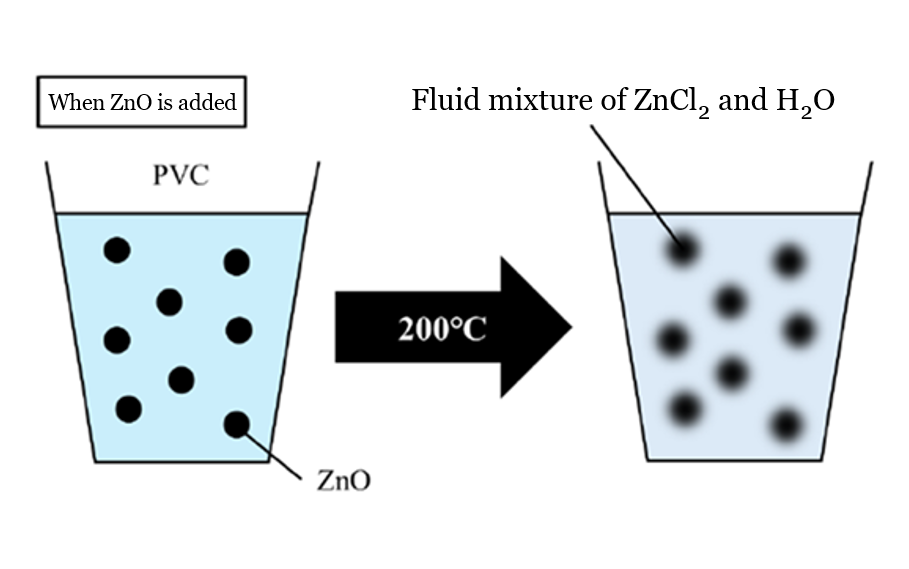
As a result of conducting evaluation using phthalate diesters with different lengths of alkyl chains as generic plasticizers, high dechlorination rates were achieved at around 200°C regardless of the type of plasticizers. In addition, it becomes easier for zinc oxide to spread uniformly throughout PVC when a plasticizer is present, suggesting that it is possible to implement this technology using a generic kneading method without requiring any special mixing method. It can be called a critical piece of knowledge in the establishment of methods for effective use of used PVC products.
As seen above, this research showed novel findings suggesting the possibility of using zinc oxide for efficient dechlorination of PVC compounds. The results of this joint research were presented at the 138th Catalysis Society of Japan (CATSJ) Meeting being held at Kumamoto University from September 9, 2026.
The RIKEN TECHNOS GROUP will contribute to the realization of a sustainable society by discovering new possibilities for the effective use of PVC and other plastics containing chloride.
▼Adsorption & Solid-state Catalysis Laboratory, Department of Materials Chemistry, Faculty of Engineering, Shinshu University
https://t-okada.jp/ (in Japanese)