News
2026/07/30
RIKEN TECHNOS and Niihama College Demonstrate PFAS Degradation in Real-World Water Environments
RIKEN TECHNOS CORPORATION (Head Office: Chiyoda-ku, Tokyo; Representative Director, President & CEO: Kazuaki Tokiwa) has collaborated on research with National Institute of Technology (KOSEN), Niihama College (Niihama-shi, Ehime Prefecture; President: Akihiro Tokai; hereinafter, Niihama College) to confirm the degradation of per- and polyfluoroalkyl substances (PFAS) in water of real-world environments such as rivers and dam water.
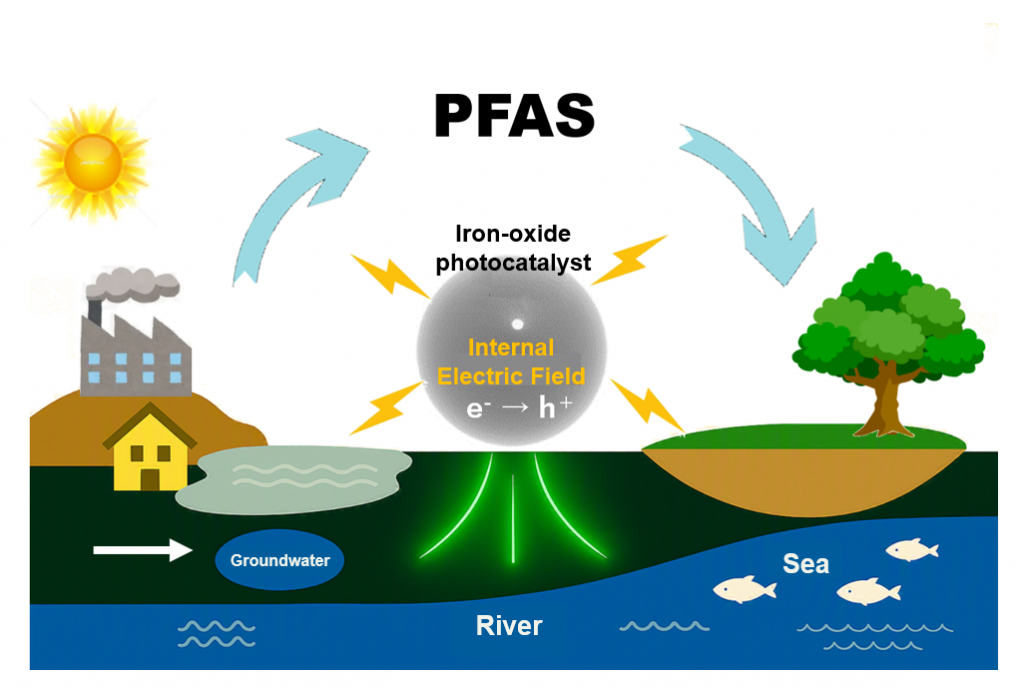
Known also as “forever chemicals,” PFAS have become a global environmental issue. RIKEN TECHNOS and Niihama College are developing a photocatalytic technology, and the results of this research show the potential for this technology to function effectively even under conditions close to real-world environments. This is an important step toward achieving practical water treatment technology for measures against PFAS.
In the future, it is expected to help municipalities and business operators that are required to handle PFAS-related monitoring and purification measures by solving issues related to environmental water—such as groundwater and rivers—and reducing the costs of measures.
- Research Background
PFAS are chemical substances that have been widely used in various products due to their property of repelling water and oil. At the same time, they are also known as “forever chemicals” because they are extremely difficult to degrade and can persist in the environment for a long time. In recent years, their health impacts and environmental persistence have become a global issue, but PFAS removal and degradation generally require significant energy input and chemical consumption, with many outstanding issues regarding practical application.
Furthermore, many previous studies have been centered on confirming the decrease in PFAS concentrations, without adequately verifying the progress of the degradation reaction.
Based on the results of studies so far, verification was conducted under this research from three perspectives: PFAS degradation evaluation, catalyst design, and reaction mechanism.
- Features of Confirmed Results
(1) Confirmation of PFAS degradation under conditions close to real-world environments
Instead of pure water, evaluation was conducted using water of real-world environments—such as rivers and dams—containing other substances. The results confirmed that, even under such conditions, PFAS exhibited changes consistent with progressive degradation.(2) Consistency between PFAS change and evaluation method
Applying the evaluation method developed so far confirmed that PFAS were not merely adsorbed onto the catalyst surface in terms of attaching to the surface of the catalyst, but went through degradation reaction in stages. This showed the potential for understanding the progress of reaction, which could not be assessed from the decrease in PFAS concentration alone.(3) Confirmation of results consistent with reaction mechanism
The changes observed in the PFAS degradation process were consistent with the reaction behavior of fluorinated aromatic compounds. This suggests that PFAS degradation resulted from a rationally designed photocatalytic system rather than a coincidental effect, based on designing photocatalysts with high reactivity using the internal electric field and an understanding of the reaction mechanism.
- Significance of Research Results
The results are significant for confirming the degradation of PFAS under conditions close to real-world environments in a form that integrates the understanding of evaluation indicators, design concepts, and the reaction mechanism, without requiring special reagents or large amounts of energy. In addition, by showing the potential for evaluating not only PFAS concentration changes but also the progress of reaction, it is expected to lead to more reliable technological development. This achievement represents an important step toward the practical implementation of photocatalytic water-treatment technology.
Measures against PFAS are expected to become an important environmental issue for municipalities and business operators in the future. In particular, the importance of continuous investigation, monitoring, and purification measures is expected to increase for environmental water such as groundwater, well water, and rivers. This technology is expected to expand the options for purification technologies needed to address such issues, leading to future regulatory compliance and reduction of social and economic burdens.
- Future Outlook
Going forward, RIKEN TECHNOS will advance verification toward optimization of processing conditions, evaluation of performance during repeated use, and expansion of processing scales, and accelerate efforts toward commercialization and practical deployment.
In addition, as a photocatalytic water treatment technology based on iron oxides, the Company will also study the potential of its application for refractory organic substances, including PFAS.
RIKEN TECHNOS will engage in collaboration with academia on development to create new technologies and solve social issues.
National Institute of Technology (KOSEN), Niihama College
https://www.niihama-nct.ac.jp/english/