News
2026/07/28
RIKEN TECHNOS and Niihama College Develop a High-Reactivity Photocatalyst Design —Basic Technology for Degradation of Persistent Organic Substances
RIKEN TECHNOS CORPORATION (Head Office: Chiyoda-ku, Tokyo; Representative Director, President & CEO: Kazuaki Tokiwa) has collaborated on research with National Institute of Technology (KOSEN), Niihama College (Niihama-shi, Ehime Prefecture; President: Akihiro Tokai; hereinafter, Niihama College) to develop a photocatalyst design that delivers both strong oxidizing and reducing power.
This foundational technology enables the degradation of refractory organic substances that have been difficult to decompose using conventional photocatalysts.
Through application to strategies for combating environmental contaminants, such as per- and polyfluoroalkyl substances (PFAS), and within the water treatment field, the technology is expected to help address environmental challenges being targeted by tighter regulation and monitoring both in Japan and overseas.
The research involved combining a set of base photocatalysts studied by Niihama College with the interface engineering and compositing expertise of RIKEN TECHNOS. The parties developed a structural design for photocatalysts that dramatically enhances performance by regulating and optimizing the behavior of charge carriers (photogenerated electrons and holes) through foreign element introduction and interface control.
More specifically, the parties determined the charge transfer mechanism and charge regulation method—which influence photocatalyst performance—through the following three design stages.
(1) Heterojunction (Type II) (a technique combining two different materials to separate electrons from holes, the positively charged carriers generated in semiconductors[1]
(2) Z-scheme (a structural design that eliminates charges not needed for the reaction, leaving behind only the strongest charges [2])
(3) S-scheme (the latest structural design, where an internal electric field selectively retains highly reactive charge carriers[3]
Although earlier heterojunction photocatalysts easily separated electrons and holes, both types of charge migrated toward lower energy states, diminishing oxidizing and reducing power and hindering generation of sufficient reactivity to degrade strong organic bonds [1]. The research addressed this issue, with the design evolving to not only separate the charges, but also harness high-energy charges that were effective for the reaction. This improvement in performance was supported by precision control of the electronic states and interface properties of the materials.
(1) Type II Heterojunction: Realizing Charge Separation
Use of an iron oxide and titanium oxide heterojunction suppressed electron–hole recombination to realize stable charge separation. However, this structural design is known to be limited in its ability to break strong organic bonds given that both electrons and holes migrate to lower energy states, diminishing oxidizing and reducing power [1].
(2) Z-Scheme: Selective Retention of High-Energy Charges
The Z-scheme charge transfer mechanism is broadly seen as a method for preserving charges with high oxidizing and reducing power by selectively recombining low-energy charges that are unlikely to contribute to the reaction [2]. In this research, the mechanism served as the basis for a structural design that regulated the interface and electron states to harness high-energy charges effectively.
(3) S-Scheme: Charge Selection Using an Internal Electric Field
The S-scheme structure is proposed as a mechanism for filtering charges using an internal electric field that forms at the interface between the two different materials [4].
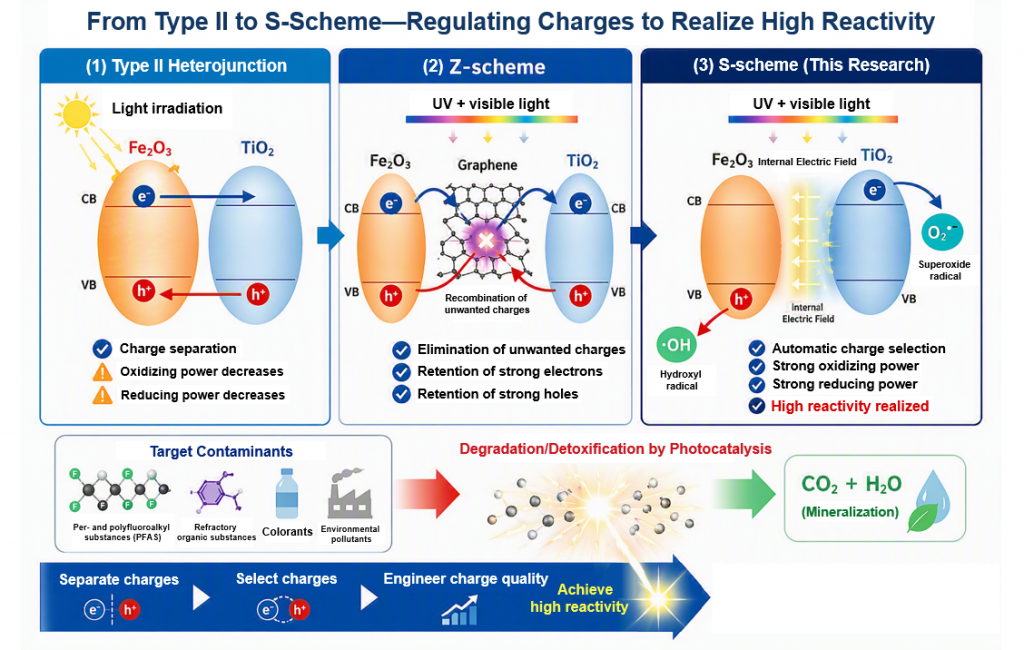
Based on this concept, the research involved developing a structural design that, through regulation of the potential difference and electronic state at the interface, enabled the selection of charges without the use of an outside mediator.
As a result, the parties determined that it was possible to simultaneously achieve charge separation and high oxidizing/reducing power, resulting in consistently high photocatalytic activity.
The core outcome of the research was the realization of a strategy to not only separate charges within a photocatalyst, but also selectively use charges with high oxidizing/reducing power that are effective for reactions.
Systematization of composite design approaches, such as this use of Type II, Z-scheme, and S-scheme mechanisms, is being pursued as an effective strategy even for iron-based photocatalysts. [5]
The photocatalyst design achieved here is a key basic technology on the path to commercialization and is expected to be applied to next-generation water treatment technology targeting PFAS and other refractory organic substances. Regulation and monitoring of PFAS have been strengthened worldwide in recent years, making the realization of highly reactive photocatalysts a priority. These findings provide a technological platform for the development of next-generation photocatalytic water-treatment systems.
The parties are now verifying the technology in real-world environmental conditions and will accelerate commercialization efforts through integrated consideration of material, process, and module design. The parties will evaluate the feasibility of application to the water treatment field, with targets including groundwater, river water, well water, and industrial wastewater, and pursue development to support conformance to PFAS countermeasures and other anticipated environmental regulations, as well as contribute to the advancement of purification technologies.
As a basic technology contributing to the improvement of capabilities for degrading refractory organic substances that have not been possible with existing photocatalysts, it is hoped the technology will lead to additional technological innovation in the water treatment field.
RIKEN TECHNOS will continue to engage in collaboration with academia on development to carve out new fields of research and create new technologies helping to address social challenges.
Key Technical Background References
[1]Balapure, A.; Ray Dutta, J.; Ganesan, R.
Recent advances in semiconductor heterojunctions: fundamentals and charge transfer mechanisms.
RSC Applied Interfaces, 2024.
https://pubs.rsc.org/en/content/articlehtml/2024/lf/d3lf00126a
[2]Qahtan, T. F. et al.
Advancements in heterogeneous photocatalysts: from classical semiconductors to cutting-edge S-scheme systems.
Springer, 2024.
https://link.springer.com/article/10.1007/s42247-024-00788-w
[3]Ghasemi, S. et al.
Recent progress on Z- and S-scheme photocatalysis: mechanistic understanding toward green applications.
Current Opinion in Chemical Engineering, 2025.
https://hal.science/hal-04862745v1/
[4]Charge-transfer dynamics in S-scheme photocatalyst.
Nature Reviews Chemistry, 2025.
https://www.nature.com/articles/s41570-025-00698-3
[5]Arif, N. et al.
Recent advances and perspectives on iron-based photocatalysts.
Journal of Materials Chemistry C, 2024.
https://pubs.rsc.org/en/content/articlehtml/2024/tc/d4tc01062k
National Institute of Technology (KOSEN), Niihama College
https://www.niihama-nct.ac.jp/english/