News
2026/05/28
RIKEN TECHNOS Collaborates with Niihama College on Research to Develop Magnetically Recoverable Photocatalytic Material for Wastewater Treatment
RIKEN TECHNOS CORPORATION (Head Office: Chiyoda-ku, Tokyo; Kazuaki Tokiwa) has collaborated with National Institute of Technology (KOSEN), Niihama College (Niihama-shi, Ehime Prefecture; President: Akihiro Tokai; hereinafter, Niihama College) to develop a material consisting of a porous matrix loaded with magnetic iron oxide particles that is easy to recover after wastewater treatment.
- Research Background
Photocatalytic water treatment requires no external chemicals and is therefore attracting attention for its low environmental impact. The method of dispersing photocatalytic particles in wastewater, however, complicates the recovery of the particles after treatment, creating challenges for practical application of the technology. Furthermore, decreasing the size of photocatalytic particles to boost their activity makes them resistant to sedimentation, further complicating filtration and recovery.
- Purpose of Joint Research
Niihama College has a proven track record in this field of technological research. RIKEN TECHNOS took note of that expertise and embarked on joint research with the college with a view toward industrial application. Leveraging formulation and manufacturing technologies and commercialization know-how accumulated in the chemicals and materials fields, RIKEN TECHNOS’ role is to translate the results of basic research into practical use, establish processes for mass production, and undertake initiatives to advance social implementation. The Company will propel the development toward practical application, undertaking material design, process development and scale-up, and feasibility assessment centered on the wealth of knowledge and technology seeds established by Niihama College.
- Features of the Newly Developed Material
RIKEN TECHNOS and Niihama College have developed a new photocatalyst for use in water treatment to help resolve the above issues. The key feature of the newly developed photocatalyst is that it combines the function of breaking down organic matter when dispersed in wastewater and the property enabling it to be easily recovered with a magnet after the water treatment process. This resolves existing post-treatment challenges of separating and recovering the photocatalysts, paving the way for application in the water treatment sector.
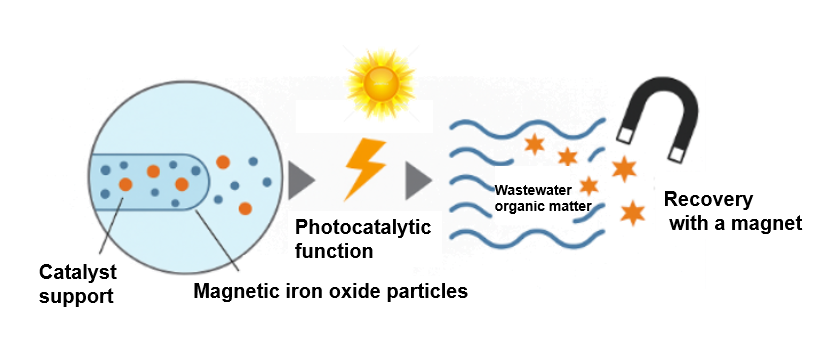
(1)Magnetic iron oxide particles supported on a porous matrix
Dispersibility in wastewater and recoverability were simultaneously achieved by supporting magnetic iron oxide particles—one or more of α-Fe₂O₃, γ-Fe₂O₃, and Fe₃O₄— on a porous matrix, such as zeolite or diatomite.
(2)Solar photocatalysis
Due to the iron oxides’ responsiveness to visible light, it is possible to degrade organic matter even in sunlight. This opens up opportunities for wastewater treatment that is not dependent on artificial light.
(3)Easy recovery with a magnet
Because the material is magnetic, it can be promptly recovered with a magnet after use, indicating compatibility with water treatment processes designed to support catalyst reuse.
- Envisaged Areas of Application
- Treatment of domestic/industrial wastewater
- Decentralized water treatment using photocatalysis
- Treatment processes designed to support catalyst recovery and reuse
- Energy-efficient water treatment making use of sunlight
The achievements reported here represent the first stage on the path toward practical application of photocatalytic material in water treatment. Steps will now be taken to optimize performance and evaluate use within real-world water systems, bringing the development even closer to practical use.
RIKEN TECHNOS will continue to engage in collaboration with academia on development to branch into new fields and create new technologies.
National Institute of Technology(KOSEN), Niihama College
https://www.niihama-nct.ac.jp/english/